

Taiwan Smart Home Market and Analysis Report – Opportunities and Forecast 2026-2033
Taiwan Smart Home Market Overview
Taiwan Smart Home Market Size was valued at USD 825 million in 2025 and is forecast to touch a value of USD 2,101 million in 2033, and the market is expected to grow at a CAGR of 12.4% from 2026-2033 owing to growing security and safety concerns, increasing integration of artificial intelligence and voice assistants, greater focus on energy efficiency, rising disposable income, and favorable government policies.
Market Size & Forecast:
-
- 2025 – USD 825 Million
- 2026 – USD 919 Million
- 2033 – USD 2,101 Million
- Market Forecast – CAGR of 12.4% from 2026-2033
Key Segment Insights:
-
- Device Category Type Insights: Smart Entertainment Systems captures a significant market share in 2025.
- Installation Type Insights: Retrofit installations driving demand for the smart home devices market in Taiwan.
- Connectivity Technology Type Insights: Wi-Fi hold the largest market share in 2025.
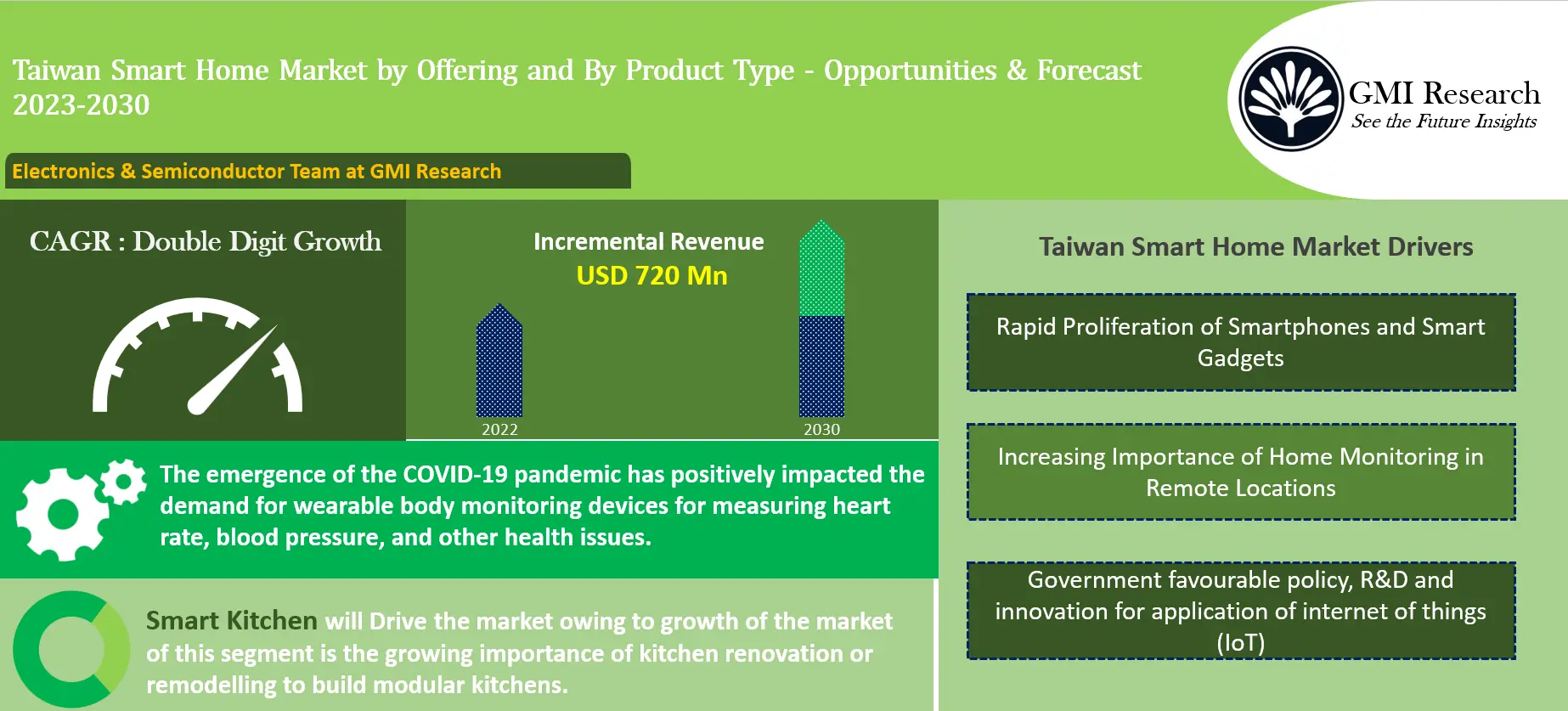
Taiwan Smart Home Market Growth Drivers
Growing Security and Safety Concerns
The integration of motion detectors, surveillance cameras, automated door locks, and biometric access controls drives consumer adoption of advanced smart home network platforms. Synchronizing fingerprints, retina scanners, and facial recognition technologies directly increases residential safety against visitors or strangers entering the property. This connected ecosystem routes real-time security alerts, accidental fire notifications, and system malfunction warnings to user smartphones or wearables globally. Home security allows active remote monitoring from any location. For systems integrators and device manufacturers, this transition to multi-sensor hardware configurations reinforces the business implication to deliver unified mobile control systems that streamline daily routines and enhance personal time management simultaneously.
Integration of Artificial Intelligence and Voice Assistants
Internet of Things (IoT) adoption is gaining traction specifically among residential consumers as it offers numerous advantages by connecting household products to the Internet. The accelerating number of internet users, along with the rising adoption of smart devices, are the two key drivers that are contributing to market growth. Taiwan’s smart home infrastructure is expanding rapidly as Ministry of Digital Affairs (MODA) data shows household internet access hit a record 93.4% in 2025, alongside a historic 90.3% individual access rate. This baseline connectivity supports widespread automation, with Mastercard Taiwan revealing that nearly 70 percent of people now use artificial intelligence (AI) agents weekly. This widespread adoption changes residential device management. Connected smart home hubs running AI parse voice commands and calendar events to automate to-do lists, reminders, and appointments. Integration of Artificial intelligence and generative AI across product lines propels the Taiwan’s smart home device adoption. Brands increasingly embed these technologies directly into their consumer device portfolios driving the Taiwan smart home market growth.
Increasing Focus on Energy Efficiency
Smart home optimize and cut residential utility waste by bringing all the smart appliances, such as lights, thermostats, and security systems into one power-tracking app. Remote wireless control lets homeowners manage everything from a distance. This real-time hardware oversight stops standby electricity drain. Continuous tracking reduces unnecessary household power consumption.
Growing Disposable Income
Increasing disposable income has further resulted in consumers opting for different smart solutions at home. This has resulted in growing demand for home and kitchen appliances among consumers. Products such as smart washers, smart dishwashers, refrigerators are witnessing a heathy growth trend. In addition to this, increasing product proliferation by leading players in this categories will further supplement the demand in the coming years. Taiwan’s gross domestic product per capita reached US$34,430 as of April 2025, according to the International Monetary Fund Expressed in purchasing power parity, Taiwan’s per capita output aligns directly with Denmark and the Netherlands, highlighting elevated domestic living standards despite global monetary pressures. This high-income baseline boosts local consumer purchasing power, offering multinationals a resilient high-yield target market for premium retail expansion and capital deployment.
Favorable Government Policies
Favourable government policies stand to be one of the key factors that is supporting the growth of the smart home market. The government is focusing on improving the life quality of its people by introducing numerous initiatives and strategies. The government launched Digital Nation & Innovation Economic Development Program (DIGI+) was launched to enhance digital infrastructure, re-construct service-based digital government, and promote the smart city concept in cities and rural areas. Thus, the growing emphasis on the development of smart cities will supplement market growth.
Challenges Faced by Taiwan Smart Home Market Companies
Smart home devices possess biggest risk of cyber-attacks as these devices as these are connected to internet and people lives may depend on the services or security provided by such devices . Therefore, manufactures need to keep cyber security as a major objective while designing smart home technologies. A joint report by NETGEAR and Bitdefender reveals that the average connected household, containing 22 IoT devices, faces nearly 30 cybersecurity attacks every 24 hours globally. Automated scanning drives 93% of these events, primarily targeting streaming devices, smart TVs, and IP cameras running unpatched firmware.
Taiwan Smart Home Market Segment Analysis
Device Category Type Market Insights: Smart Entertainment Systems captures a significant market share
Networked video entertainment devices, including smart TVs, streaming devices, and internet-connected set-top boxes, command the significant market share of the Taiwan smart home devices market. Audio and volume control devices are also gaining popularity as consumers seek greater convenience in managing and controlling entertainment systems at home. This demand supports wider adoption of connected entertainment technologies, particularly devices that integrate multiple functions into a single home network. For smart home technology providers, the trend strengthens the focus on connected entertainment products that simplify device management and improve the user experience.
HVAC system deployment has increased owing to growing focus on improving energy efficiency. These requirements are encouraging the adoption of systems that meet higher efficiency standards.
The growing importance of kitchen renovation or remodelling to build modular kitchens is a key driver that is boosting the market growth. Individuals are now looking for smart kitchen appliances such as cookware, cooktops, and dishwashers, which can be controlled by devices such as Amazon Echo or Google Home. Furthermore, the expansion of the leading players in the Taiwan market is further opening new doors for the segment growth.
Installation Type Market Insights: Retrofit installations driving demand for the smart home devices market in Taiwan
Retrofit installations driving demand for the smart home devices in the country owing to their ability to integrate existing systems without extensive rewiring or structural modifications. This approach uses wireless technologies, smart plugs, sensors, and controllers that integrate with existing electrical and lighting infrastructure. That makes smart home upgrades more convenient and cost-effective for homeowners.
Connectivity Technology Type Market Insights: Wi-Fi hold the largest market share in 2025
Wi-Fi accounted held the largest market share as it the most widely preferred connectivity technology for smart home applications. The higher adoption of Wi-Fi is due to its simple installation, and compatibility with existing home networks support its wider usage. This allows consumers to connect and manage smart home devices without requiring additional connectivity infrastructure.
Taiwan Smart Home Market Major Players & Competitive Landscape
Several leading companies are Xiaomi, Google, Apple, Amazon, Samsung, LG, Delta, Siemens AG, ABB, Schneider Electric and many more.
Xiaomi has pursued an aggressive strategy to penetrate and drive its smart home products in Taiwan by using affordable, connected products to broaden its local customer base. Xiaomi has opened Mi Home and direct-sales stores to further strengthen its product distribution across the country and also to have deeper customer access. The strategy focused on building a broader connected-device ecosystem rather than relying on a single product category.
Key Taiwan Smart Home Market outlook
GMI Research’ analyst projects that, the Taiwan Smart Home Market was valued at USD 825 million in 2025 and is projected to reach USD 2.10 billion by 2033, registering a CAGR of 12.4% from 2026 to 2033. Rising adoption of connected home technologies is supporting market expansion across Taiwan. The market’s growth will increase demand for smart-home devices, connected solutions, and supporting technologies through the forecast period.
Taiwan Smart Home Market Scope of the Report
|
Report Coverage |
Details |
| Market Size Value in 2025 |
USD 825 Million |
| Market Size Value in 2026 |
USD 919 Million |
| Market Revenue Forecast in 2033 |
USD 2,101 million |
| CAGR |
12.4% |
| Market Base Year |
2025 |
| Market Forecast Period |
2026-2033 |
| Base Year & Forecast Units |
Revenues (USD Million) |
| Market Segment | By Device Category, Residence Type, Installation Type, By Connectivity Technology |
| Regional Coverage | Taiwan |
| Companies Profiled | Xiaomi, Google, Apple, Amazon, Samsung, LG, Delta, Siemens AG, ABB, Schneider Electric among others; a total of 10 companies covered. |
| 25% Free Customization Available | We will customize this report up to 25% as a free customization to address our client’s specific requirements |
Taiwan Smart Home Market Research Report Segmentation
The Taiwan Smart Home Market has been segmented on the basis of Device Category, Residence Type, Installation Type, Connectivity Technology. Based on Device Category, the market is segmented into Smart Entertainment Systems, Security and Access Control Systems, Lighting, HVAC, Healthcare Solutions, Kitchen, and Others. Based on Residence Type, the market is segmented into Single-Family and Multi-Family. Based on Installation Type, the market is segmented into New Installation and Retrofit Installation. Based on Connectivity Technology, the market is segmented into Wi-Fi, Zigbee, Z-Wave, Bluetooth BLE, and Others.
Taiwan Smart Home Market by Device Category
-
- Smart Entertainment Systems
- Security and access control systems
- Lighting
- HVAC
- Healthcare Solutions
- Kitchen
- Others
Taiwan Smart Home Market by Residence Type
-
- Single-Family
- Multi-Family
Taiwan Smart Home Market by Installation Type:
-
- New Installation
- Retrofit Installation
Taiwan Smart Home Market by Connectivity Technology
-
- Wi-Fi
- Zigbee
- Z-Wave
- Bluetooth BLE
- Others
Taiwan Smart Home Market Leading players
-
-
Xiaomi
-
Google
-
Apple
-
Amazon
-
Samsung
-
LG
-
Delta
-
Siemens AG
-
ABB
-
Schneider Electric
-
Frequently Asked Question About This Report
Taiwan Smart Home Market – Report Code [UP1557A-00-0620]
According to GMI Research analyst estimates, Taiwan Smart Home Market size was estimated at USD 825 million in 2025
Key factors supporting the Taiwan Smart Home Market include heightened demand for security and safety solutions, wider integration of artificial intelligence and voice assistants, increasing emphasis on energy efficiency, rising disposable income, and favorable government policies that support smart-home adoption.
GMI Research believes the Tiawan smart home market has strong opportunity for expansion and the market size is forecast to touch a value of USD 2,101 million in 2033, and the market is expected to grow at a CAGR of 12.4% from 2026-2033.
Major players are Xiaomi, Google, Apple, Amazon, Samsung, LG, Delta, Siemens AG, ABB, Schneider Electric and many more.
Networked video entertainment devices, such as smart TVs, streaming devices, and internet-connected set-top boxes, hold a significant share of the Taiwan smart home devices market. Their widespread use reflects strong consumer demand for connected entertainment solutions. This segment is expected to remain an important component of the market as households increasingly integrate internet-enabled devices into their home environments.
Retrofit installations dominate the market share and are supporting demand for smart home devices in Taiwan by allowing homeowners to integrate connected technologies with existing systems without extensive rewiring or structural modifications. This makes upgrades simpler. The approach can reduce installation complexity and support smart-home adoption across existing residential properties, where major electrical or structural changes may be impractical.
Wi-Fi held the largest market share in the Taiwan smart home devices market in 2025, supported by its widespread use as the preferred connectivity technology for smart home applications. Its established presence across connected devices supports seamless integration with existing home networks.
Related Reports
Why GMI Research